
Clinton Projected Versus Actual Release
ODRC labels its public field “Expected Release Date/Parole Eligibility Date.” It can be a projected release date or a date pending parole consideration. “PRD” means projected release date, while “POA” means parole on or after. Eligibility for Board review is not approval to leave prison. A pretrial detainee at Clinton County Jail usually has no sentence-based date. Bond, a new court order, dismissal, another hold, or a case result can control when custody ends.
A sentenced county-jail inmate’s date comes from the court journal, jail-time credit, and the jail’s own calculation. State prisoners follow ODRC records and Ohio law. The actual event appears later in a final jail release entry or ODRC release detail.
Find a Clinton County Projected Release
First decide whether the person remains in the county system or entered ODRC. The sheriff’s Active Inmates page answers only who appears in current county custody. It does not calculate state-prison dates or preserve a release archive. A move from the jail to ODRC is a transfer, not a community release.
- Confirm the person and case in Municipal Court or Common Pleas. Read the sentence, jail-time credit, and later orders.
- For a local sentence, ask Clinton County Jail for its official calculation and final release entry.
- For state prison, open the ODRC Offender Search and use the offender number when possible.
- Compare identity, county of commitment, sentence, status, and the full expected-date label.
- Reopen the detail near the date and check release detail, parole action, supervision status, and newer orders.
The Clinton County release search explains how to pair the sheriff record with both local courts. Common Pleas is vital for felony sentencing and judicial release. Municipal Court covers matters within its jurisdiction. Neither docket is a real-time jail-door log.
Ohio Credit Shapes Clinton Release Dates
ORC 2967.194 controls productive-participation earned credit from April 4, 2024, forward. An eligible prisoner may receive provisional credit at one or five days per completed month of qualifying participation, with a possible added amount for a second qualifying program. ODRC records credit monthly. Violations can lead to denial or withdrawal.
The aggregate monthly and program-participation credit is capped at fifteen percent of the stated term for an eligible prisoner. Mandatory terms, murder and aggravated murder, life without parole, certain Chapter 2971 terms, and other listed categories are excluded. Earlier credit can fall under former ORC 2967.193 and bridge language. OAC 5120-2-06 supplies administrative rules.
The phrase “serve 85%” is not a universal Ohio rule. It describes only an eligible term receiving the maximum credit within that cap. It does not fit every mandatory, life, indefinite, parole-eligible, or excluded sentence. The filed judgment and ODRC calculation control.
Why Clinton Release Dates Change
A projected date reflects records that can change. Save the date viewed and check the official detail again before relying on it.
| Factor | Effect | Record |
|---|---|---|
| Credit correction | Moves the calculated term | Court journal and ODRC detail |
| Earned credit | May move an eligible date | ODRC calculation |
| Detainer or hold | Can block community release | Custodian and court record |
| Amended or consecutive sentence | Changes total time | Filed sentencing entries |
| Parole decision | Grants, denies, or continues review | Board record |
| Judicial release | Creates a court-ordered route | Court order and ODRC detail |
Confirm Clinton County Actual Release
VINELink can send a custody-change alert when a participating source reports an event. Search the correct person, compare identifiers and custodian, choose the offered event and contact method, and finish the confirmation. Telephone registration may require a private PIN.
An alert can lag and may not explain bond, transfer, sentence completion, or another outcome. Confirm a county release through the sheriff’s final entry and the court journal. Confirm state release through ODRC release detail.
Clinton Dates for Indefinite Terms
Covered non-life indefinite terms add a special layer. Under ORC 2967.271, release is presumed at the diminished minimum term or applicable presumptive earned early-release date. ODRC can rebut that presumption after the required hearing and continue confinement on statutory grounds. The process may recur, but confinement cannot exceed the court-imposed maximum.
Old-law and life or indefinite parole cases also require care. ORC 2967.13 supplies eligibility rules for categories it covers, and the Board decides suitability after an eligibility point. A hearing date is not an exit date.
Clinton County Jail Date Calculation
No official Clinton County policy was found for a special local good-time formula, fixed release hour, or automatic weekend adjustment. Ask for the existing sentence-calculation or release entry and the filed court journal. Do not apply ODRC prison credit rules to a local jail stay without support.
A county detainee can also leave due to bond, dismissal, probation, transfer, or another hold. Only some paths are community releases. When destination is unknown, say the person left Clinton County Jail custody until the record identifies what happened.
Read Clinton Projected Release Fields
Read the ODRC detail as a group. “Incarcerated” means still in prison. “APA Supervision” means release from prison under state supervision. “Judicial Release” points to a sentencing-court order. “Parole or Release Detail” appears after release or parole. County of commitment can connect the state case to Clinton County, while residential county and ZIP serve a different role for people under APA supervision.
The official ODRC definitions explain the compound date field shown below.
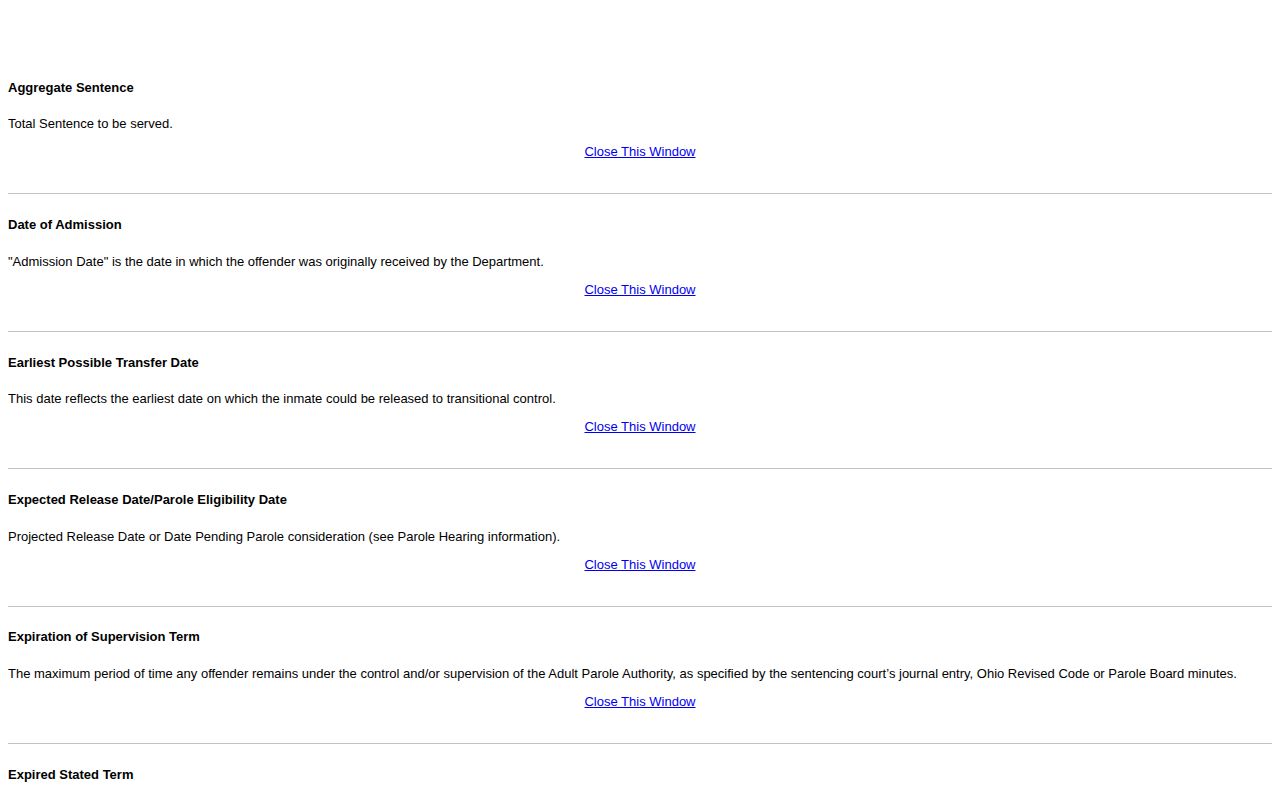
The captured definition confirms why sentence type must guide how the displayed date is read.
Clinton Sentence Structure Controls Dates
A sound date check begins with the journalized sentence and ODRC admission, then accounts for jail-time credit and the structure of the term. Definite, indefinite, life, mandatory, consecutive, and concurrent terms do not work alike. Post-release control is a supervision term after prison and should not be added to the expected prison exit as if it were confinement.
Judicial release requires a sentencing-court order under Ohio law. Transitional control can place an eligible prisoner in community confinement before sentence expiration. Parole requires Board action for a qualifying case. Each route has its own record, and none should be inferred from a date standing alone.
The ODRC aggregate sentence and published field definitions are safer than a homemade calculator. Even correct arithmetic cannot account for an unposted court order, a hold from another authority, a disciplinary decision, or a Board action.
Clinton Parole Eligibility Date Checks
When the expected-date field represents parole eligibility, the public search offers another useful control. Enter the Next Parole Board Hearing Date as a month in YYYYMM form. ODRC says results are people currently scheduled for that month and year. A search by the named person or offender number remains more precise than treating the monthly results as a fixed calendar.
A favorable Board outcome may identify release on or after a later date and may include conditions. A denial can establish later consideration. A continuance postpones the matter. ODRC definitions note that Board review may occur before the future indicated date, so the date cannot be read as a promise that a hearing or exit occurs on that exact day.
No centralized live index of all Ohio parole decisions was verified. A focused records request for a named determination, order, and minutes is the appropriate fallback under OAC 5120:1-1-36.
Match Clinton Release Date Records
ODRC advises using fewer criteria rather than overconstraining the form. A last-name search can match names that begin with the entered text and may include suffix variants. Open each plausible result and compare the offender number, complete name, county of commitment, case, admission, and sentence. Never select a record from name alone.
A county-only detainee who bonded out or served a misdemeanor term may never have an ODRC record. In that situation, the correct sources are Clinton County Jail and the relevant court. By contrast, someone conveyed from the jail to an Ohio prison should later appear as incarcerated in ODRC. That person left the county roster but was not released to the community.
A federal sentence uses the Bureau of Prisons locator, while current immigration detention uses ICE’s locator. Neither federal system supplies the Ohio prison calculation or the Clinton County Jail release entry.
Clinton Actual Release Record Proof
The strongest county proof describes the final custody entry for a specific booking. Give the booked name, birth date if known, booking number, booking date, case number, and a narrow date range. Ask for the date and time custody ended, the disposition, and any nonexempt transfer destination or receiving agency. If the office does not keep one document titled “release record,” request the existing entries that contain those fields.
Court and jail records answer different parts of the question. The journal explains the legal basis, such as bond, dismissal, jail credit, sentence, or transfer. The jail entry provides the operational custody-end time. When the two seem inconsistent, ask the responsible offices about posting lag or a later order.
Record the “as of” date for every online check. A projected release should never be used to arrange an irreversible event without direct confirmation from the current custodian.
Recheck Clinton Release Date Updates
Public systems do not share one guaranteed refresh schedule. The sheriff describes its roster and mobile tools as live or recent, but no numeric interval is published. ODRC data can change after sentence calculations, earned-credit entries, Board action, or court orders are processed. Court dockets may also trail judicial action. A careful record therefore states which system was checked and when.
If two dates conflict, compare the filed sentencing journal, later amended entries, ODRC sentence detail, and the current custodian’s calculation. The newest screen is not always the controlling legal record. A court may have acted before an online docket image appears, or a receiving agency may still be processing intake.
Ask a focused question when calling. For Clinton County Jail, identify the booking and ask whether the displayed or calculated date reflects all current holds. For ODRC, identify the offender number and the exact field label. Avoid asking an office to confirm a date pulled from an unrelated custody system.
After the event, replace the projection with actual proof. The county final custody entry or ODRC release detail gives the release event, while a supervision field can show whether legal oversight continues in the community.