
Clinton County 72-Hour Release Evidence
A reliable three-day result begins with the records that persist after the live roster changes. The sheriff’s final custody entry can supply the date, time, and disposition. A transport entry may identify a receiving jail or ODRC destination. Municipal Court or Common Pleas records can then explain the bond, sentence, dismissal, community-control order, or prison conveyance tied to that movement. These sources should be reconciled by booking identifier and case number.
MobilePatrol and VINE add timely notice, but neither is the official three-day ledger. Record the alert time and agency, then seek the matching custody entry. This keeps a notification from being mistaken for a complete historical list and prevents a transfer from being reported as community release.
Clinton County 72-Hour Release Access
The Clinton County Sheriff’s online custody product is expressly named Active Inmates. It answers who is shown in the jail now. The official sweep found no web control or separate URL for released people, recent releases, or a rolling three-day report. There is also no published cadence or retention term for a release feed that was not found.
A three-day review is still possible through the underlying records. The interval must be made concrete. For example, a requester can name a start date and time, an end date and time, and the Eastern time zone. That avoids the moving target created by asking vaguely for “the last three days.” It also lets the custodian identify existing entries without creating a new compilation.
Check Clinton County Three-Day Releases
Begin with the period, not a list of names copied from the current roster. The correct record set is all existing final release or transfer entries whose custody-end timestamps fall within the fixed window. If the office already keeps a compiled report, request it. If it does not, Ohio public-records law does not generally require the creation of a new report, so ask for responsive entries in the form maintained.
- Write the exact 72-hour start and end timestamps.
- Ask the sheriff for existing final release or transfer entries in that interval.
- Request name, booking identifier, booking time, custody-end time, disposition, and destination where recorded.
- Separate community-release language from transfers to another custodian.
- Match each event to Municipal Court or Common Pleas records when the reason matters.
The Clinton County Jail is at 1645 Davids Drive in Wilmington. Its published voice lines are (937) 383-4813 and (937) 383-3292. Those lines can address operational questions and direct a records inquiry. For a focused same-day interval, use the Jail Releases: 24 Hours method.
Clinton County 72-Hour Record Fields
No online Clinton County three-day table supplies standardized fields. A proper field inventory must therefore describe the existing jail release or transfer entry, not pretend the current roster contains historical data. Identity fields connect an event to a booking. Timing fields define whether it belongs within the window. Disposition and destination explain whether local custody ended in the community or elsewhere.
| Requested field | How it helps |
|---|---|
| Booked name and identifiers | Distinguish people with similar names. |
| Booking number and time | Connect the custody ending to one admission. |
| Release or transfer time | Determine whether the event falls inside the fixed window. |
| Release disposition | Identify the recorded reason custody ended. |
| Destination or receiving agency | Separate community release from continued custody. |
| Court or case number | Locate the journal entry that explains the legal action. |
A booking photo is not a release field. “Bond” does not mean the prosecution ended, and “transfer” does not mean freedom from custody. A hold can also keep a person confined after one Clinton County basis ends. Each label must be read with the full entry.
Clinton County Weekend Release Checks
A three-day interval is useful when a search crosses a weekend, holiday, or uncertain date. It offers a broader records scope than the same-day request. Yet the research found no Clinton County rule promising that weekend events post to a public feed on a certain schedule. There is no basis for claiming a numeric refresh rate or predicting when a jail entry, app alert, or docket entry will appear.
Use fixed timestamps and record when each source was checked. Court data can lag behind judicial action. Alerts depend on agency data transmission. The jail’s final release or transfer entry is the best local source for the operational custody-end time, while the filed court journal explains the legal basis. Pairing them avoids forcing one system to answer both questions.
Clinton County’s two courts also require care. Municipal Court covers cases within its jurisdiction, while Common Pleas is the key felony route. A Common Pleas sentence can order transport to ODRC. Such a conveyance may fall in the requested 72-hour custody-ending window, but it is not a community release.
Reconcile Clinton County Release Entries
A 72-hour return may contain several kinds of custody endings. Sort them by what the existing disposition and destination fields actually say. A bond or recognizance entry can describe return to the community under court terms. Completion of a local jail sentence may also end custody. By contrast, a destination naming ODRC, another county jail, a federal authority, or another custodial placement signals continued custody even though the person has left Clinton County Jail.
When the disposition is unclear, use the case number to locate the controlling court. A bond-posting or dismissal entry may explain a pretrial change. A sentencing journal can show jail-time credit, community control, or an Ohio prison term. A filed judicial-release order is stronger evidence than a calendar notation. The court record supplies legal context, while the jail entry supplies the time the local custody episode ended.
Never count the same event twice merely because it appears in MobilePatrol, VINE, and a jail response. Those are separate reports about one person’s movement. Match the name, booking identifier, case, and time before treating records as one event. If the sources conflict, confirm the status with the custodian shown and describe when each display was checked.
MobilePatrol’s Clinton County Role
The sheriff’s MobilePatrol description lists live detention-center access, recent bookings in chronological order, person searches, and automated release notifications. That makes it a practical tool when following a known active record. It does not promise a browsable 72-hour release table, a fixed archive duration, or full historical coverage.
Select the Clinton County, Ohio agency and verify the candidate before enabling a notification. Search fields described by the sheriff include first and last name, age, gender, and alphabetical browsing. Current app controls govern because labels and features can change. Save a registration confirmation where offered. An alert is a report of a custody-data change, so confirm it through the jail record and court.
The sheriff’s official feature page is shown below and supports those limited uses.
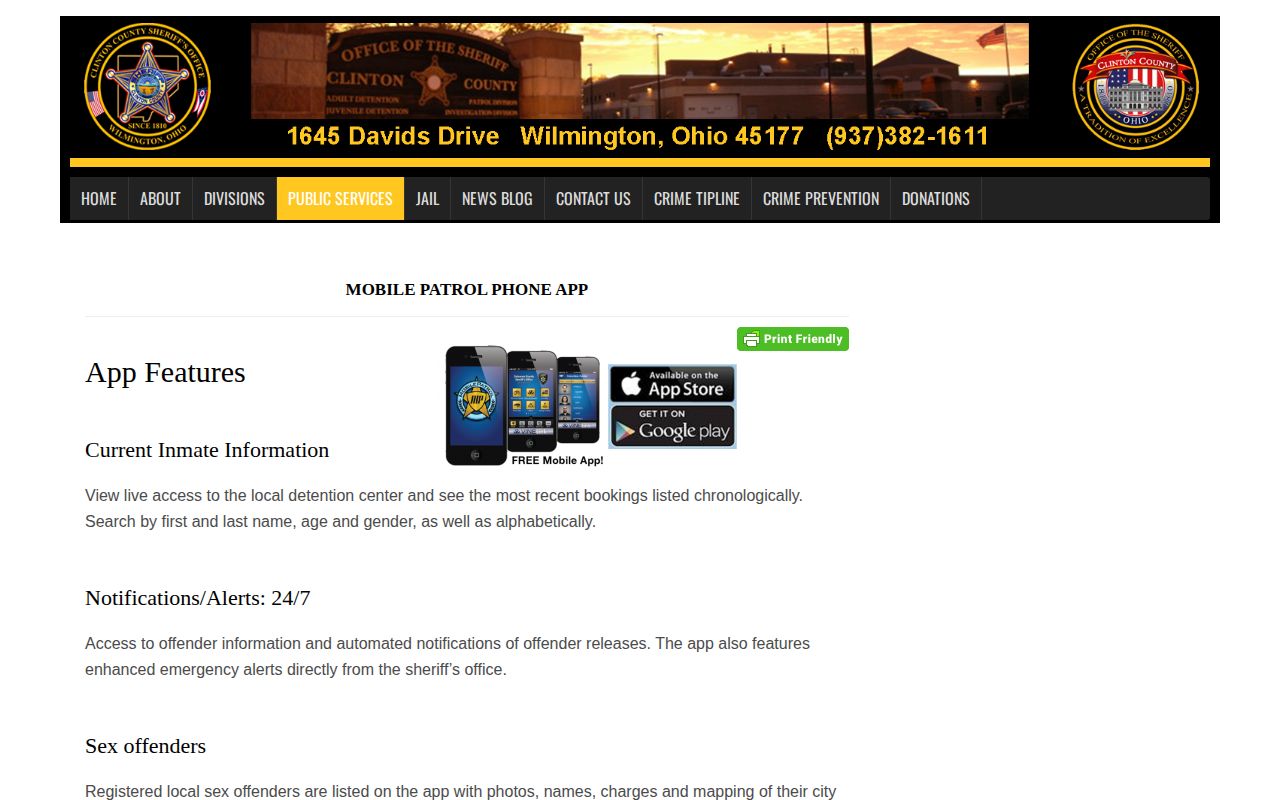
The image documents a notification route, not a guaranteed three-day archive or complete release ledger.
Clinton County Roster Absence Explained
Clinton County’s distinctive data quirk is an official live roster with no verified web release archive. A name can disappear because of bond, completion of a local term, dismissal, a court order, a transfer to another jail, transport to state prison, or another custodial change. Absence alone cannot select among those outcomes.
The current roster can be inspected through the official sheriff route. Note the check time and treat the heading as a statement of scope.
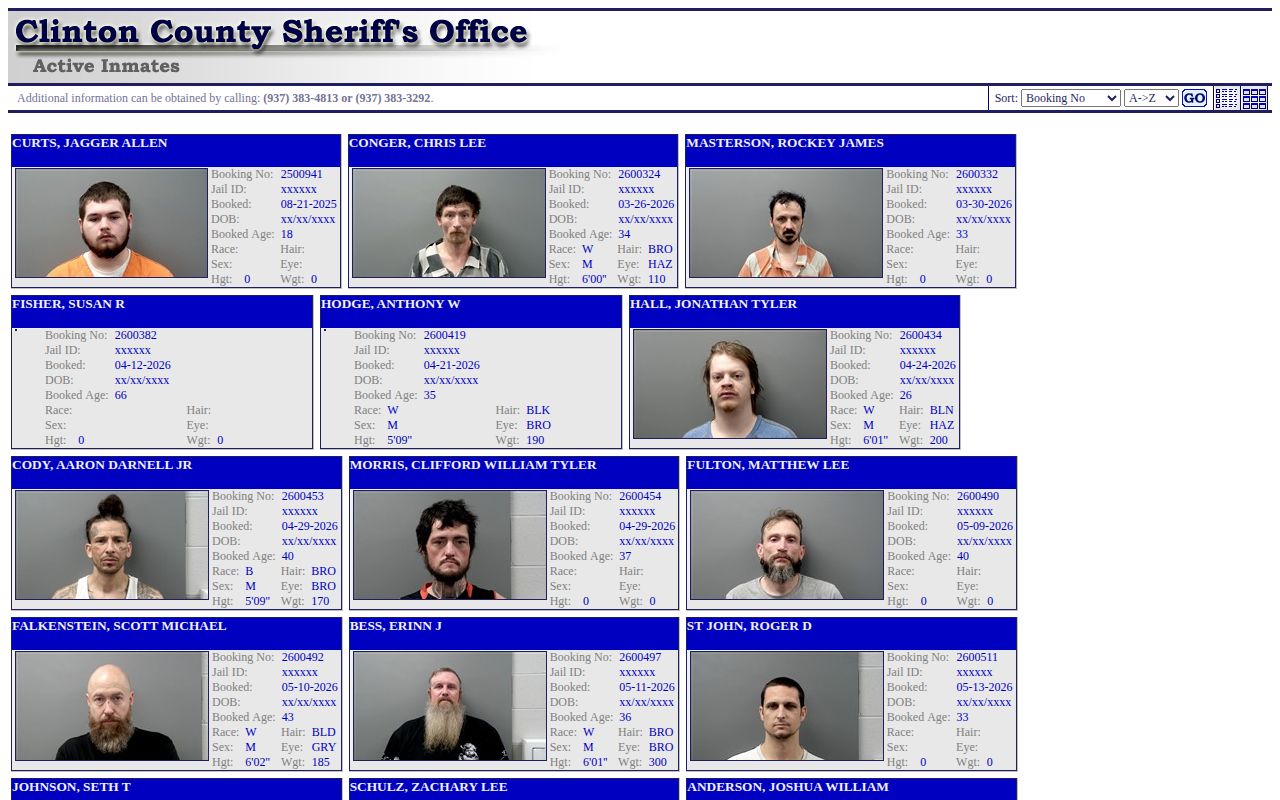
The display is useful for present custody. Historical proof comes from records that remain after the live row is gone, including the jail entry, transport entry, and court docket.
Verify Clinton County Custody Endings
Use the system tied to the actual custodian. A county-only detainee may never appear in ODRC. A person conveyed from Clinton County Jail to an Ohio prison should appear as incarcerated in the ODRC Offender Search after intake. That is continued state custody. ODRC’s Released, APA Supervision, and Judicial Release information applies to people within the state correctional system, not every former county detainee.
VINE and MobilePatrol can supply timely alerts. Municipal and Common Pleas dockets can show bond, dismissal, sentencing, credit, or conveyance. The BOP locator is reserved for federal sentenced custody. None serves as a universal three-day Clinton County archive.
- Current custody
- A person still displayed on the official Active Inmates roster.
- Community release
- A documented end of custody with no receiving custodian or unresolved hold shown.
- Transfer
- A move that ends Clinton County custody but continues confinement elsewhere.
- Notification
- A reported status event that must be confirmed with the originating record.
For one named person, the Clinton County released-inmate search follows the full local, state, court, and federal decision path. Keep the three-day list intent focused on a fixed group of custody-ending records.