
Clinton County Jail Release Paths
A person can leave Clinton County Jail through bond, recognizance, time served, sentence completion, dismissal, acquittal, probation, or another court order. Those outcomes generally lead to the community unless another hold applies. A felony prison sentence instead leads to an ODRC transfer. Movement to another county jail, federal authority, treatment placement, or other custodian also ends the Clinton roster entry without ending all custody.
The strongest local proof pairs the sheriff’s final booking and release or transfer entry with the filed court journal. The jail entry supplies the actual custody-end time and may name a disposition or destination. The court docket often supplies the legal reason. When the destination is unknown, say the person “left Clinton County Jail custody.” Reserve “released to the community” for a record that supports it.
| Path | Record to check next |
|---|---|
| Bond or recognizance | Jail release entry and court bond order |
| Time served or dismissal | Final jail entry and filed disposition |
| Probation or community control | Sentencing journal and Adult Probation |
| Ohio prison sentence | ODRC Offender Search after intake |
| Other-agency transfer | Destination field and receiving custodian |
Confirm Clinton County Jail Release
The Sheriff’s Active Inmates page is a present-custody roster. It has no verified historic release filter. A missing name can signal release, transfer, or another administrative move, so follow the record chain rather than treating roster absence as proof.
- Enter through the official Sheriff page and check Active Inmates for current custody.
- Search Municipal Court for matters in its jurisdiction or Common Pleas for felony and prison-sentence records.
- Ask the Sheriff for the final custody-end entry, disposition, and public destination field tied to the booking.
- If a state transfer appears, search ODRC by name or number and review status and release detail.
- Use MobilePatrol or VINE as notification aids, then verify any alert against the jail and court record.
Leaving the Clinton County Jail roster is not the same as being released to the community. A transfer also removes the current entry.
The Clinton County released inmate search explains the broader county, state, federal, and records-request paths. At this facility, the sheriff record plus the court journal remains the primary confirmation pair.
Clinton County Jail Record Contact
Operational questions and record requests may use different staff routes. The jail numbers address current custody and facility matters. Sheriff Records maintains and files sheriff reports and provides copies through public-record requests. Confirm the current custodian and delivery method before sending personal identifiers.
1645 Davids Drive
Wilmington, Ohio 45177
Jail: (937) 383-4813 or (937) 383-3292
Jail fax: (937) 383-0276
Sheriff: (937) 382-1611
Ask for the existing booking and final release or transfer record for the named booking. Useful details include the booked name, date range, booking number, case number, custody-end time, disposition, public destination, and associated booking photo. No verified Clinton County Sheriff fee schedule for this specific record was found. Request an estimate and prefer electronic copies where available.
Clinton County Jail Custody
The Clinton County Sheriff’s Office operates this full-service county jail. The current facility opened in 2001 and has 92 beds. Its population includes male and female detainees in general-population units and people in disciplinary, administrative, or medical segregation. It holds pretrial detainees, people serving local jail sentences, and people awaiting transport to another jail or prison.
That mixed role explains why roster removal is ambiguous. A pretrial detainee may post bond. A locally sentenced person may finish a term. Someone sentenced on a felony may be conveyed to an ODRC reception site. Court Services also transports people to proceedings, appointments, prisons, and jails across Ohio. The final Clinton County Jail entry and destination must guide the next search.
Courts Confirm Clinton Jail Releases
The Municipal Court search covers cases within that court’s jurisdiction. It allows one search field at a time, except a name may be paired with date of birth. Its official warning directs users to verify warrant information with the clerk before official action. The Common Pleas route matters for felony disposition, state-prison sentences, and judicial release.
Online dockets are not real-time jail-control tools. A posting can lag court action. Yet filed orders can explain the legal basis for custody ending long after the active roster row disappears. Use the jail record for the actual departure time and the court journal for the order. If the journal sends the person to prison, continue with ODRC rather than calling that event a community release.
Clinton Jail Release Alerts
The Sheriff’s MobilePatrol page describes live detention-center access, chronological recent bookings, person search, and automated release notifications. The county’s VINE page documents local participation in the notification network. Both can help track a matching active record.
An alert reports a custody-data event. It may not say whether the reason was bond, time served, dismissal, transfer, or another outcome. Neither official page promises a permanent Clinton County Jail release archive, an exact refresh interval, or a fixed retention term. Register while the matching custody record is active when possible, save the confirmation, and compare an alert with the final jail entry.
Services End After Clinton Release
The jail-information page states that personal mail for someone no longer held is returned with an “Inmate No Longer in Custody” marking. That local wording helps explain why contact tools stop, but returned mail does not reveal a legal reason or destination. It should not be used as a release test.
Digital mail, video visitation, commissary, and jail communications serve people in custody. A failed transaction does not independently prove why custody ended. Family or counsel seeking property or release logistics should call the jail. The reviewed official pages did not publish a fixed release hour, public waiting area, property-pickup procedure, or weekend schedule, so those details must be confirmed for the individual booking.
The official jail information shown here identifies the facility contact and no-longer-in-custody mail rule.
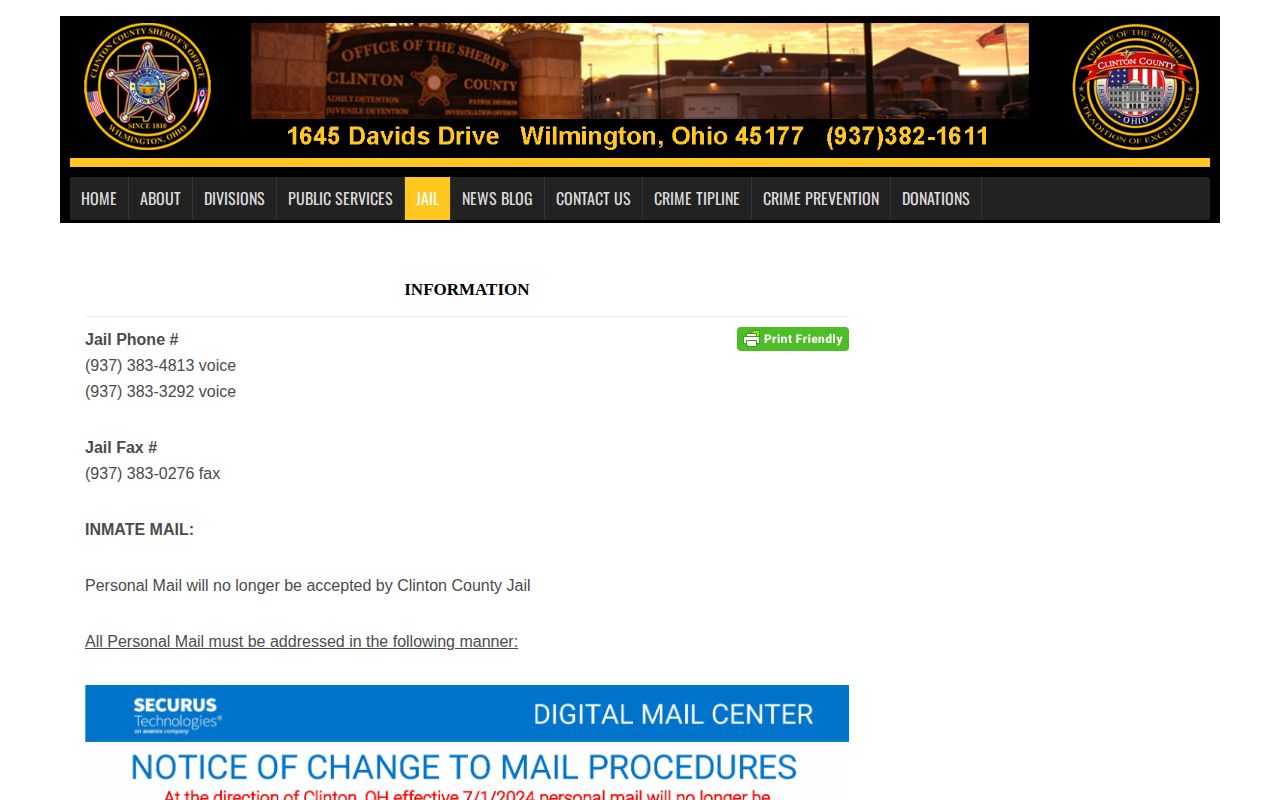
The page supports direct confirmation when a roster entry or in-custody service has ended.
Request Clinton Jail Release Records
Ohio Revised Code 149.43 governs requests to the Sheriff, subject to statutory exceptions. Federal FOIA does not control a county jail request. Describe the existing record rather than asking staff to create a custom finding. For one person, request the jail booking and final release or transfer entry. Include the full booked name, an approximate booking range, date of birth if known, booking or case number, and the fields needed to identify when and how Clinton County Jail custody ended.
A focused request can seek the booking number, booking date and time, release or transfer date and time, disposition, public destination or receiving-agency notation, and the booking photograph tied to that stay. A photograph supports identity but is not release proof. If part of the responsive record is withheld, ask the office to cite the legal basis and provide any reasonably separable public portion.
- Call the official Sheriff contact route to confirm the current records custodian.
- Send the narrow request with enough booking detail to distinguish the person.
- Ask for electronic copies and a cost estimate before chargeable work.
- Compare the response with the filed Municipal or Common Pleas court journal.
The law calls for prompt inspection and copies within a reasonable period. It does not set a guaranteed same-day answer for this request. Copy and delivery charges depend on lawful actual cost and the chosen medium. Clinton County publishes no verified special price for a jail release entry or historic booking photograph, so request an estimate rather than relying on an unrelated service fee.
Sealed, expunged, juvenile, medical, victim-identifying, confidential, and security-sensitive material may be restricted or redacted. If an official search no longer returns a case, do not assume the reason. Search limits and record migration can also affect access. The proper clerk can address court copies, while ODRC handles state-prison records after a transfer.
Clinton County Records & Archives appears in the county directory, but that listing alone does not show that it holds current jail-management records. Use it only as a routing contact if the Sheriff directs the request there. A state-prison record follows a different chain: locate the person in ODRC first, identify the ODRC number and institution, and then direct any fuller institutional-record request to the state agency. Court journal copies come from the clerk that filed the entry.
For a federal move, a county transport notation may be the last local fact. A sentenced federal prisoner can be checked in the BOP locator, while a pretrial person held for the U.S. Marshals Service may require the federal docket and responsible custodian. Clinton County Jail is not documented as a federal prison or dedicated ICE detention center. Those systems are conditional transfer paths, not added Clinton County facilities.