
Understanding Clinton County Releases
“Released” does not always mean free of all custody. A person may leave Clinton County Jail on bond, recognizance, time served, dismissal, acquittal, probation, or another community order. The same roster removal can follow transport to an Ohio prison, another jail, a treatment placement, or a federal custodian. The safe phrase is “left Clinton County Jail custody” until a final entry shows the destination. Clinton County released inmate records should be read with the court journal because the jail records the custody event while the court record often explains its legal basis.
The Clinton County Sheriff’s Office operates the county jail and maintains sheriff records. Municipal Court handles matters within its jurisdiction, while Common Pleas records felony proceedings and state-prison sentences. The Ohio Department of Rehabilitation and Correction, or ODRC, becomes the main source after a state transfer. VINE and MobilePatrol can signal a change, yet neither replaces the release entry. These lines matter. A missing live-roster row is a clue, not proof of a community release.
- Discharge
- The formal end of a sentence or supervision term.
- Time served
- A release based on custody time credited toward a sentence.
- Detainer
- A request or authority that may keep a person held for another agency.
- Judicial release
- A court-ordered early release under Ohio law, distinct from parole.
Clinton County Release Paths
The release disposition and destination determine the next valid search. A court order may return someone to the community, place the person under probation, or send the person into another form of custody. Transfers should never be described as community releases. The following distinctions reflect the Clinton County Jail population and the official state and court routes documented for it.
| Custody-ending event | Meaning | Best next source |
|---|---|---|
| Bond or recognizance | Community release while the case continues, unless another hold applies | Jail release entry and court bond order |
| Time served or sentence complete | Local sentence has ended | Release entry and sentencing journal |
| Dismissal or acquittal | The case outcome may support release, subject to other holds | Filed court disposition and jail record |
| Probation or community control | Court supervision in the community | Sentencing entry and Adult Probation |
| ODRC conveyance | Transfer into state prison custody | ODRC Offender Search after intake |
| Other custodian | Transfer to another county, federal authority, or placement | Destination field and receiving agency |
A final record can use agency-specific wording. Preserve it. “Transferred,” “released,” “judicial release,” and “APA supervision” are not interchangeable. If the destination field is withheld or blank, the court docket and receiving system may resolve the gap. A new ODRC record points to state custody. A bond entry points toward a community release, though an unrelated hold may still intervene.
Clinton County Release Record Fields
“Release record” is a useful description, not a promise that Clinton County uses one form with that title. Proof may be spread across the jail-management entry, booking sheet, transport notation, and court journal. A narrow request should identify the booked person and seek the final custody-ending entry. The recorded time and disposition are stronger evidence than a name disappearing from Active Inmates.
| Field | What it establishes |
|---|---|
| Booked name and identifiers | Connect the entry to the correct person and booking |
| Booking number | Ties the release event to one jail stay |
| Booking date and time | Marks the start of that recorded custody period |
| Release or transfer time | Shows when Clinton County custody ended |
| Disposition or reason | Records bond, time served, transfer, or other coded outcome |
| Destination or receiving agency | Distinguishes community release from continued custody when recorded |
| Case number | Connects the jail event to the court journal |
| Booking photograph | Supports identity but does not prove release |
A release date without the disposition can be misleading. Likewise, a court order without the jail’s actual custody-end time does not show when processing finished. Pair both records when timing and legal cause matter. Medical, juvenile, victim-identifying, confidential, security-sensitive, sealed, or expunged material may be restricted or redacted.
Request Clinton County Release Records
Ohio law permits requests for existing public records, subject to exceptions. Federal FOIA is not the law that governs the Clinton County Sheriff. Start with the Sheriff’s Records function and confirm the current delivery method through the official contact channel. No verified sheriff fee schedule for a jail release entry or booking photo was found. Ask for an estimate, since lawful copy and delivery costs depend on the medium.
- Identify the full booked name, approximate booking date, date of birth if known, and related court case number.
- Ask for the existing booking and final release or transfer entry, including timestamps, disposition, and public destination fields.
- Request the booking photo separately if it is stored apart from the jail entry.
- Prefer an electronic copy and ask for a cost estimate before chargeable work begins.
- If part is withheld, ask for the legal authority and the reasonably separable public remainder.
1645 Davids Drive
Wilmington, OH 45177
(937) 382-1611
Administrative hours: 8:00 a.m.–4:00 p.m.
ccso@clintonsheriff.com
Ohio’s framework calls for prompt inspection and copies within a reasonable period, not a guaranteed same-day response. Clinton County Records & Archives is a useful routing contact, but the published directory does not prove that office holds current jail-management data. Confirm the actual custodian first. ODRC prison material and court journal copies require separate routes through ODRC and the proper clerk.
Ohio Law on Clinton Releases
Ohio Revised Code 149.43 supplies the public-record framework for inspection, copies, redaction, and statutory exceptions. It does not make every fact about an arrest public. Each record and withheld field must be tested under the current law. The office may redact protected parts while producing a reasonably separable public portion.
Sealing and expungement fall under Chapter 2953. Eligibility depends on the case, outcome, offense, count, and final discharge. A release date alone cannot answer it. Sealing limits ordinary access rather than changing the historic event, while expungement has the meaning set by the controlling statute. If an official search no longer returns a case, do not infer why. Search limits, spelling, migration, and a court order can all affect access.
Mail After Clinton County Release
The jail’s official mail policy gives Clinton County a plain marker for the end of current-custody services. Mail addressed to someone no longer held is returned with an “Inmate No Longer in Custody” marking. That language explains why mail, video visitation, commissary, and jail communications can stop after a roster change. It does not state whether the person posted bond, completed a sentence, entered another jail, or moved into ODRC custody.
Returned mail is not a search method. Family members or counsel who need property or release-logistics information should call the jail. The reviewed official material did not publish a fixed release time, exit location, property-pickup process, or weekend timetable. Those details should be confirmed for the specific booking rather than assumed.
Find a Clinton County Release
The correct sequence follows custody. The official Sheriff home page links to the direct-IP Active Inmates system. That roster answers who is shown in jail now. It has no verified released-person archive or release filter. Record the time of the check, but never treat absence as the answer.
- Search Active Inmates for present Clinton County Jail custody.
- Check Municipal Court or Common Pleas using the case type and filed entries.
- Search ODRC when the court imposed prison or state supervision.
- Use VINE or MobilePatrol for a custody-change alert, then verify it.
- Use BOP or ICE only when the case or transfer points to federal or immigration custody.
- Request the sheriff’s final release or transfer entry when online sources do not settle the question.
A released person usually leaves the live roster, but a transfer does too. Only the final record and destination distinguish the two.
For a named person, the full chain is more reliable than any single screen. The current Jail Releases: 24 Hours process explains how to frame a timestamp request when no county feed exists. Court data can lag, and app alerts depend on agency transmission. Preserve names, dates, and case numbers across searches so that similar records are not mixed.
ODRC Clinton Release Search
The ODRC Offender Search covers state incarcerated, released, judicially released, Adult Parole Authority supervised, and violator-at-large records within its stated scope. It is not an archive of ordinary Clinton County jail stays. Use it after a prison sentence, state transfer, judicial release, parole, or post-release control appears in the court record.
| Search field | Best use |
|---|---|
| Last and first name | Broad person search with spelling checks |
| ODRC number | Most precise state-record match |
| County of commitment | Narrows the sentencing county |
| Residential county or ZIP | Supports location-based narrowing where published |
| Status | Separates incarcerated, released, APA, and other listed groups |
| Parole hearing month | Uses the YYYYMM monthly query for scheduled people |
The detail may show status, sentence, admission data, release detail, supervision information, and an Expected Release Date/Parole Eligibility Date. That compound label may be a projection or an eligibility point, not a promise. Read it with the status and release detail. A Clinton County detainee who never entered state custody may have no ODRC result.
The official ODRC form shown here displays the state search fields and status controls.
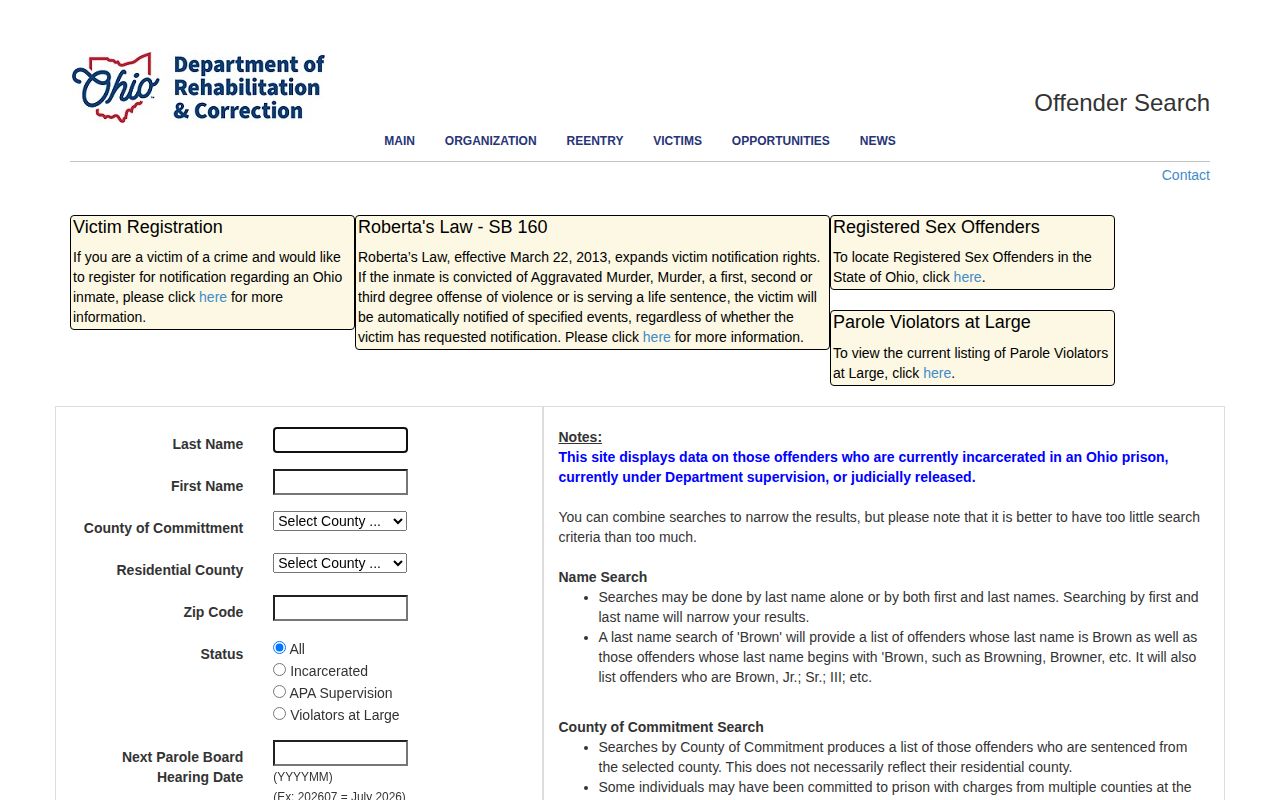
The form helps separate a state release or supervision record from a county-only jail event.
Clinton County Recent Release Gap
No distinct sheriff-hosted 24-hour or 72-hour released list was verified. The public web product is titled Active Inmates. It should not be relabeled as a release list, and saved daily roster views would miss people booked and released between checks. The Sheriff’s MobilePatrol page describes chronological recent bookings, person search, and automated release notifications, but it does not promise a browsable release archive, fixed window, or retention term.
For a time window, ask for existing final release or transfer entries between exact start and end timestamps with the time zone. Request name, booking identifier, booking time, custody-end time, and disposition, subject to lawful redaction. If a compiled report exists, ask for it. If not, seek the underlying entries without requiring staff to create a new analysis.
Two Clinton Release Court Searches
Clinton County release verification often needs two court systems. The Municipal Court search covers matters in that court and permits one search field at a time, except name plus date of birth. Its warning says warrant information must be verified with the clerk in person before official action. The Common Pleas gateway is the key path for felony sentencing, prison conveyance, and judicial release.
Neither docket is a live jail door log. Posting may trail court action. Still, a filed bond order, dismissal, sentencing entry, or judicial-release order can explain why Clinton County custody ended and can outlast the roster row. Quote the filed journal when exact disposition matters.
Verify Clinton County Roster Access
Clinton County’s Active Inmates roster is hosted at a numeric internet address instead of the main Sheriff domain. Enter through the official Sheriff home page link. That route helps distinguish the authentic Ohio county roster from commercial mirrors and from counties with the same name in other states.
The current roster screen shown here is labeled for active custody.
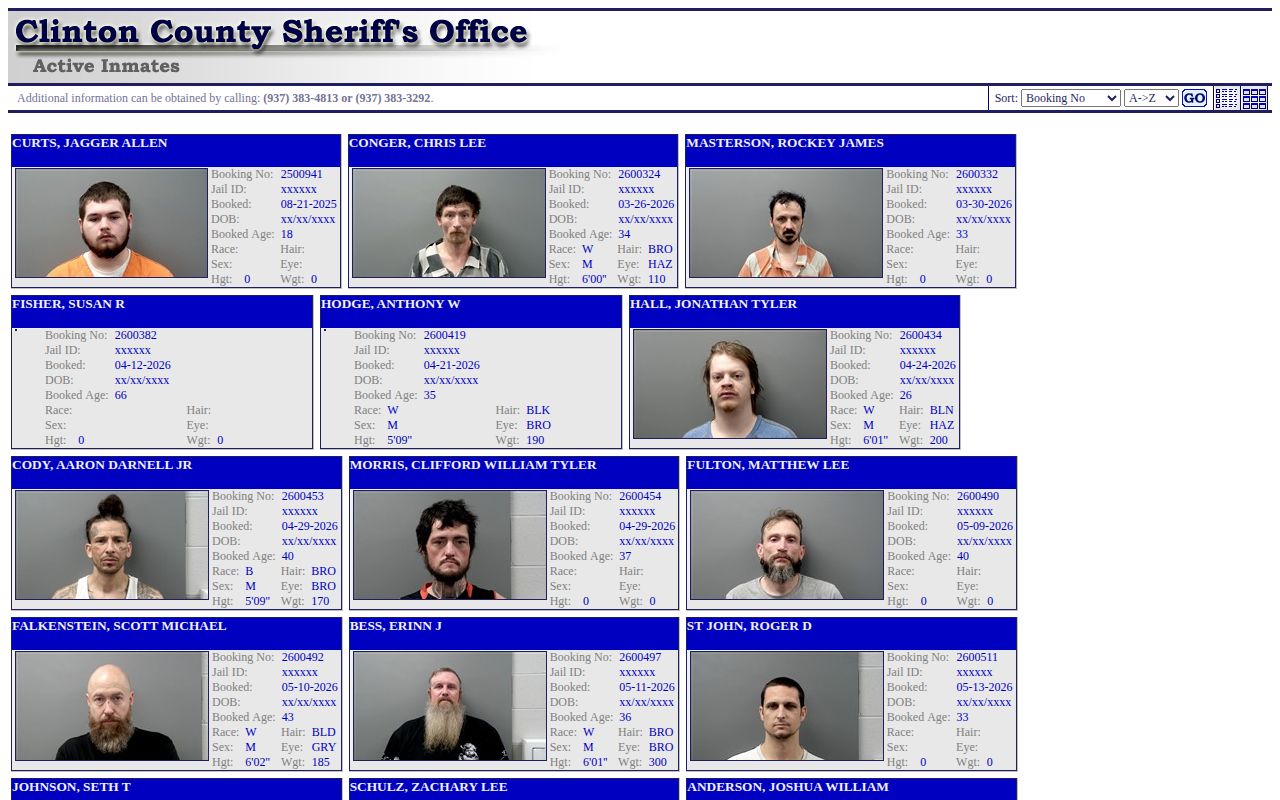
Its current-custody heading is the reason a missing name must be followed through the jail record, court, and any receiving system.
Clinton County Release Supervision
Probation, often called community control in Ohio records, comes from the sentencing court and is handled locally through Clinton County Adult Probation. State parole and post-release control are different. ODRC’s Adult Parole Authority manages those forms of state supervision. Read the sentencing journal first, then use the agency named by that record.
ODRC status can show APA Supervision, Judicial Release, or Violator at Large within its published categories. Those labels need context from the detail and court record. A person can be out of prison but still under supervision. Final discharge ends the relevant supervision term; jail release and final discharge are not necessarily the same date. Clinton County Adult Probation and ODRC provide the local and state verification routes.
Clinton Release Alerts and Transfers
Clinton County VINE connects local custody and case data to notification services, while MobilePatrol offers sheriff-endorsed release alerts. Register on a matching record when possible. A VINE event may report released or out-of-custody status, but it may not identify bond, time served, transfer, or dismissal. Confirm the alert through the jail entry and court journal.
Federal cases use separate tools. The BOP Inmate Locator covers the stated federal population and may show Released or Not in BOP Custody with a release date. It does not cover ordinary county or Ohio prison custody. A person held for the U.S. Marshals Service may be in a contract site and may not appear as expected in BOP. The federal docket and responsible custodian then matter.
ICE’s locator covers current detainees and a limited recent-release period described in official resources. An A-number search uses nine digits and country of birth, while the biographical route uses exact names and country of birth. A county departure under a detainer should be called a transfer when documented, not a community release or deportation by assumption.
Where Clinton Release Records Appear
Each system answers a narrow question. Match the source to the custodian before drawing a conclusion.
| Source | Still in custody | After custody changes |
|---|---|---|
| Sheriff Active Inmates | Shows people currently listed in Clinton County Jail | No verified release archive; disappearance is ambiguous |
| Sheriff release record | May tie back to booking data | Final time, disposition, and destination when recorded and public |
| Court docket | Shows bond and pending case entries | Shows filed disposition, sentence, or release-related order |
| ODRC Offender Search | Shows covered state custody | May show released, judicial release, or APA supervision detail |
| VINE or MobilePatrol | May show participating custody status | May send a custody-change alert; not certified proof |
| BOP or ICE | Applies only to the relevant federal system | May show federal release or limited ICE status information |
Clinton County Release Facility
The Facility Map identifies one locally operated adult detention site: Clinton County Jail. It holds pretrial detainees, people serving local jail sentences, and people waiting for transport to another jail or prison. A community release is confirmed through the sheriff record and sentencing court. A state-prison transfer moves the search to ODRC. VINE or MobilePatrol can add a timely alert, but the originating record controls.
No ODRC prison, federal prison, or dedicated ICE detention center was verified within Clinton County. State and federal systems remain possible custody paths, not extra local facilities. This prevents a statewide institution from being mislabeled as a Clinton County jail and keeps each release search tied to the agency that actually held the person.